Own the user’s intent
Keep request identity through a retry; distinguish a deliberate new export.
KNOWLEDGE & LEARNING
GenieWorks builds shared project understanding, examines later bugs and rework, and proposes lessons. Your team can inspect what it learned and how the next task changes.
Follow the work01 · UNDERSTAND THE SYSTEM
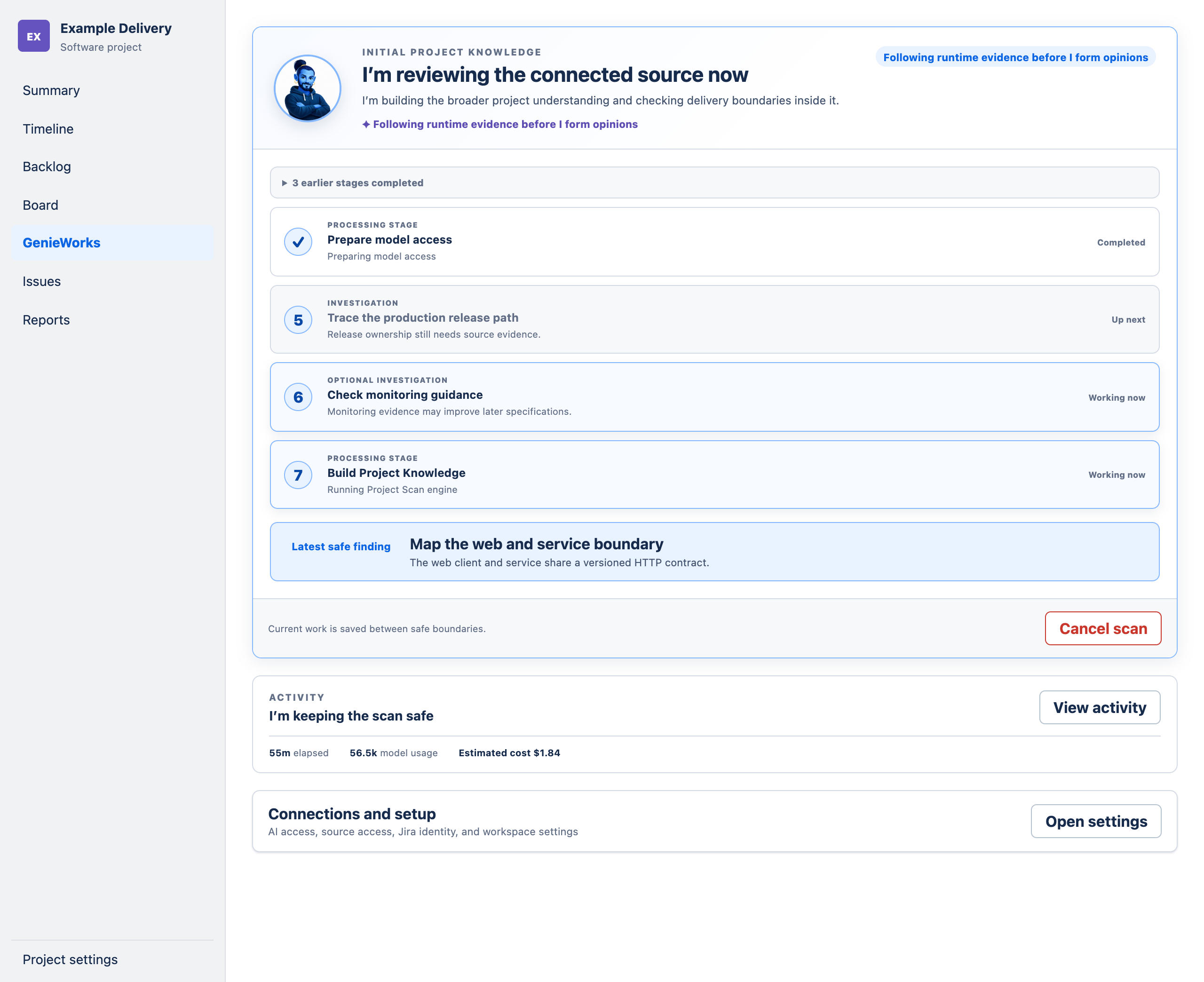
Project Scan investigates the source and delivery boundaries. Project Knowledge exposes the resulting architecture, component ownership, and engineering rules for your team to inspect.
Keep request identity through a retry; distinguish a deliberate new export.
Separate request acceptance, authorization, and asynchronous file generation.
Name the required behavior and the checks that will demonstrate it.
A validated initial Knowledge baseline can enter use awaiting review. Later replacements require an authorized activation decision. Each run records the context revision it used.
02 · EXAMINE WHAT HAPPENED LATER
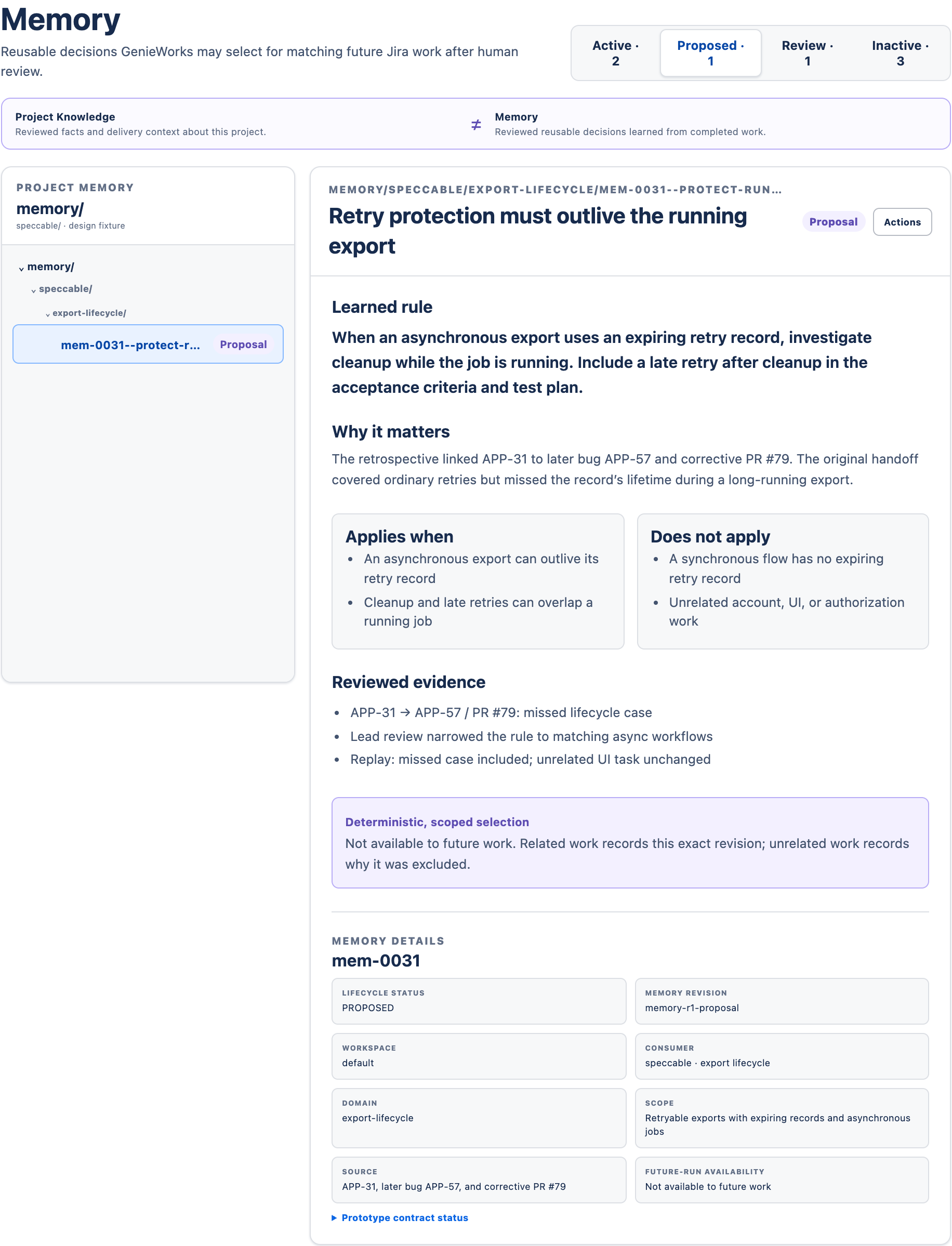
In this earlier example, GenieWorks compares APP-31 with bug APP-57 and corrective PR #79. The original specification handled ordinary retries; the later correction exposed the missing cleanup/running-job overlap.
It separates an obligation the work missed from a newly requested feature, then proposes the reusable lesson. The lead narrows its scope before activation.
Project learning · Conversation with leads

I linked APP-31 to APP-57 and PR #79. We missed what happens when cleanup removes retry protection before the export finishes. I propose adding that lifecycle investigation to matching work.
Keep the lesson specific to asynchronous jobs with expiring retry records. Do not add it to every API change.
Check it against the original task and an unrelated UI task. We need the missing scenario without unrelated requirements.
The replay adds the missed lifecycle case to the original specification and leaves the UI task unchanged. The scoped lesson is ready for review.
03 · REVIEW, ACTIVATE, AND REUSE
After the lesson is reviewed and active, APP-86 includes the lifecycle criterion and planned check. Its run records the lesson used. This is a subsequent example, not a claim that APP-42 produced this history.
 Open full screenshot
APP-86 · THE VISIBLE DIFFERENCE
The team does not have to reconstruct the correction in another prompt.
Earlier agreement A retry returns the original export
Later matching task A retry still returns that export when cleanup becomes eligible while the job is running. Hold the worker and exercise that overlap in the test plan.
The replay demonstrates changed requirements and planned verification. It does not claim that the application scenario has already been executed.
A SHARED TEAM CAPABILITY
Corrections and later delivery evidence can improve the working method. Your team reviews the proposed lesson, sees where it applies, and can inspect the revision selected for a run. An export-lifecycle lesson leaves unrelated work alone.
CONTINUE THE WORK
See how shared context becomes evidence, scope, and acceptance in a new specification.
 Open full screenshot