
AI COST REPORTING
Follow AI spending
to the work behind it
GenieWorks connects usage to the task, person, model, and outcome. Follow an expensive run into its calls and activity, then decide what to improve.
Follow the work01 · FIND THE WORK BEHIND THE TOTAL
Start with who, when, and what ran
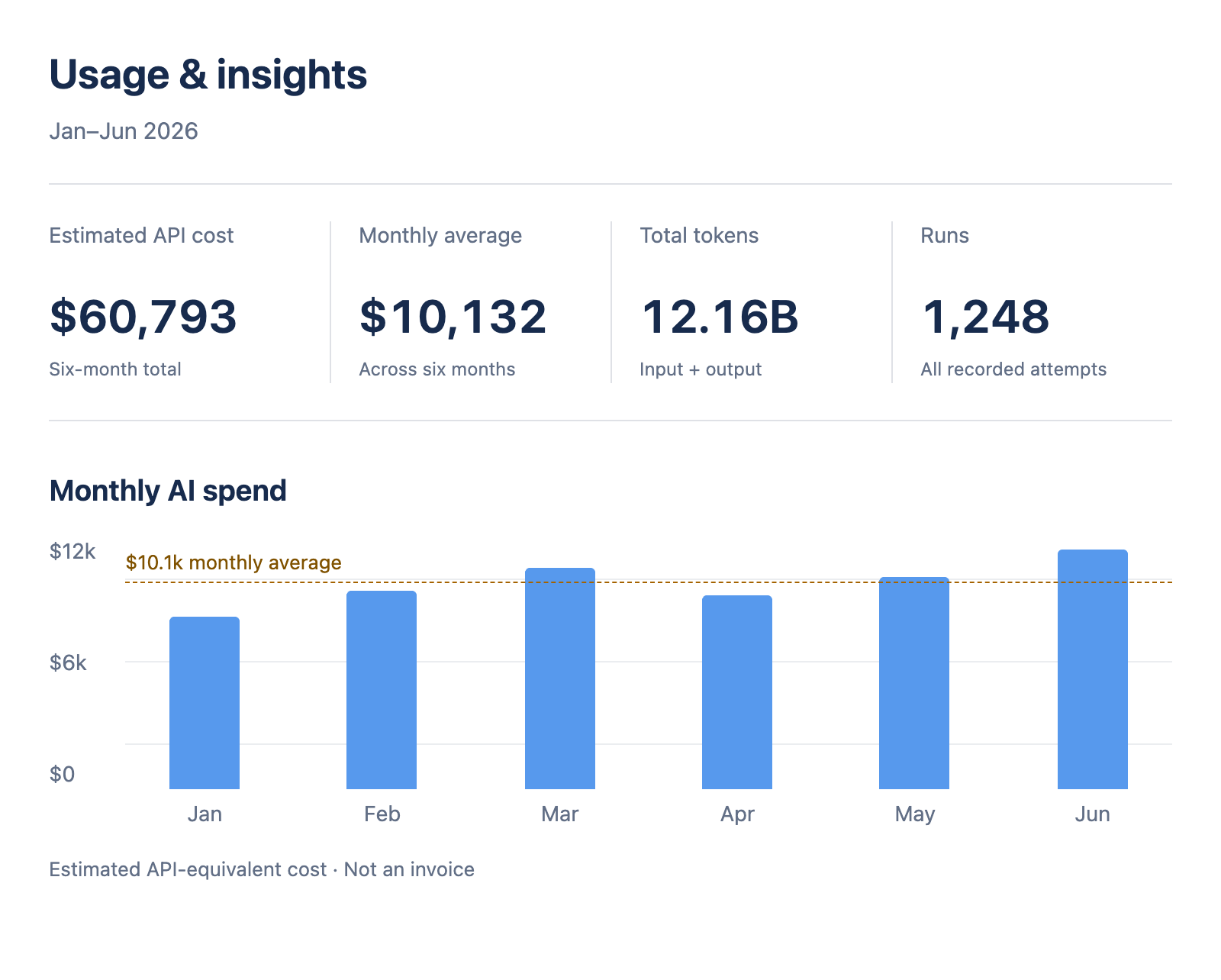
The monthly view shows totals and changes over time. The ticket list makes the spending concrete: which task ran, who started it, which model it used, and its estimated cost. Separate rates for new input, cache writes, cached input, and output explain how the tokens become dollars.
Here, Maya’s APP-58 specification run stands out. Follow that run before deciding whether the answer is a different model, a different method, or justified investigation.
02 · INSPECT THE INVESTIGATION
Three full reads deserve a closer look
APP-58 used 9.52M tokens across 64 investigation calls ($37.97), 2.406M across 18 specification calls ($11.01), and 1.02M across 8 acceptance-review calls ($5.26).
Inside the investigation, api-schema.json was read in full three times. A strong prompt can repeat this expensive discovery when the repository does not expose a useful, smaller contract surface.
The trace gives you a cause to investigate, not just a larger total.
- 109:14:08 · Call 12 · Read api-schema.json
738 KiB returned
- 209:16:42 · Call 27 · Read the same file
738 KiB returned
- 309:19:11 · Call 43 · Read the same file again
738 KiB returned
03 · FOLLOW THE EVIDENCE
From the monthly picture to the next experiment
The gallery keeps one dataset throughout: overview, APP-58, and its improvement proposal. Ticket rows are a subset of the period total; file bytes do not establish exact per-file tokens or cost.
 Open full screenshot
04 · MATCH THE MODEL TO THE WORK
Reserve premium models
for exceptional complexity
A model such as Fable 5 or GPT-6 Astra should earn its place through the difficulty of the task. Routine investigation and well-specified changes deserve a lower-cost route that meets the same engineering requirements.
For APP-58, GenieWorks suggests reviewing the model choice: a bounded investigation of existing export paths and schema ran entirely on Fable 5. Try Sonnet 4.6 for equivalent work and compare the specification, evidence, and acceptance coverage.
Repricing the recorded token categories gives $37.97 in potential API savings per run. This isolates model rates; it does not include a saving from narrower file reads.
Standard Anthropic API rates, checked September 21, 2026. Same token counts and cache mix; actual tokenization, calls, cache hits, and repair work can change. No cheaper run has been measured in this example.
05 · TEST THE IMPROVEMENTS
Change one thing
Check the outcome
Test the model suggestion with the original task, context, and workflow. Compare the resulting specification and acceptance coverage, including any retries or repair work needed to reach the same standard.
Separately, test selecting the relevant schema objects before reading the API contract. Keep the model fixed for that comparison; a line limit alone would not bound a single-line JSON file.
The model saving is a rate-only estimate. Savings from narrower reads remain unmeasured; do not add the two together.
A SHARED TEAM CAPABILITY
Keep the explanation with the work
The next teammate can inspect the initiator, run, calls, and evidence without reconstructing someone’s private session. The improvement becomes a recorded comparison the team can repeat.
CONTINUE THE WORK
Choose the model with the work in view
Inspect model and deployment choices, or see how a clear specification enables a cheaper implementation model.
See the model handoff