Preserve the request
Keep its identity after a lost response. Give a deliberate new export a fresh identity.
SPECIFICATION
GenieWorks investigates the request, brings the decisions to your team, and turns the agreed outcome into work an engineer can build and verify.
Follow one requestEmail, Slack, or Zendesk → your existing Jira intake → GenieWorks
01 · INVESTIGATE
GenieWorks checks the reported behavior against the code and live evidence before accepting the proposed fix.
Here, Sentry records a lost response. The connected Internal API shows a second job after the retry. Disabling the button would leave that path untouched.
The evidence changes the fix
The response never reaches the browser
A new request identity reaches the API
The same intent has become two exports
Selected project MCP connections
02 · BOUND THE CHANGE
A queue redesign would add work without resolving the missing agreement about request identity. This example needs coordinated Web and API changes.
Keep its identity after a lost response. Give a deliberate new export a fresh identity.
Recognize the retry and return the existing job within the caller’s allowed scope.
The existing worker can process the single accepted job. No worker task is needed for this fix.
Other investigations can use Prometheus, Grafana, Better Stack, or your own internal services through compatible MCP connections selected for the project.
03 · AGREE ON THE BEHAVIOR
The code can explain why duplicates happen. It cannot decide what your customer should see when they retry.
GenieWorks raises that choice with its evidence. The answer and QA’s agreement stay with the issue, ready for implementation to use.
APP-42 · Comments & history

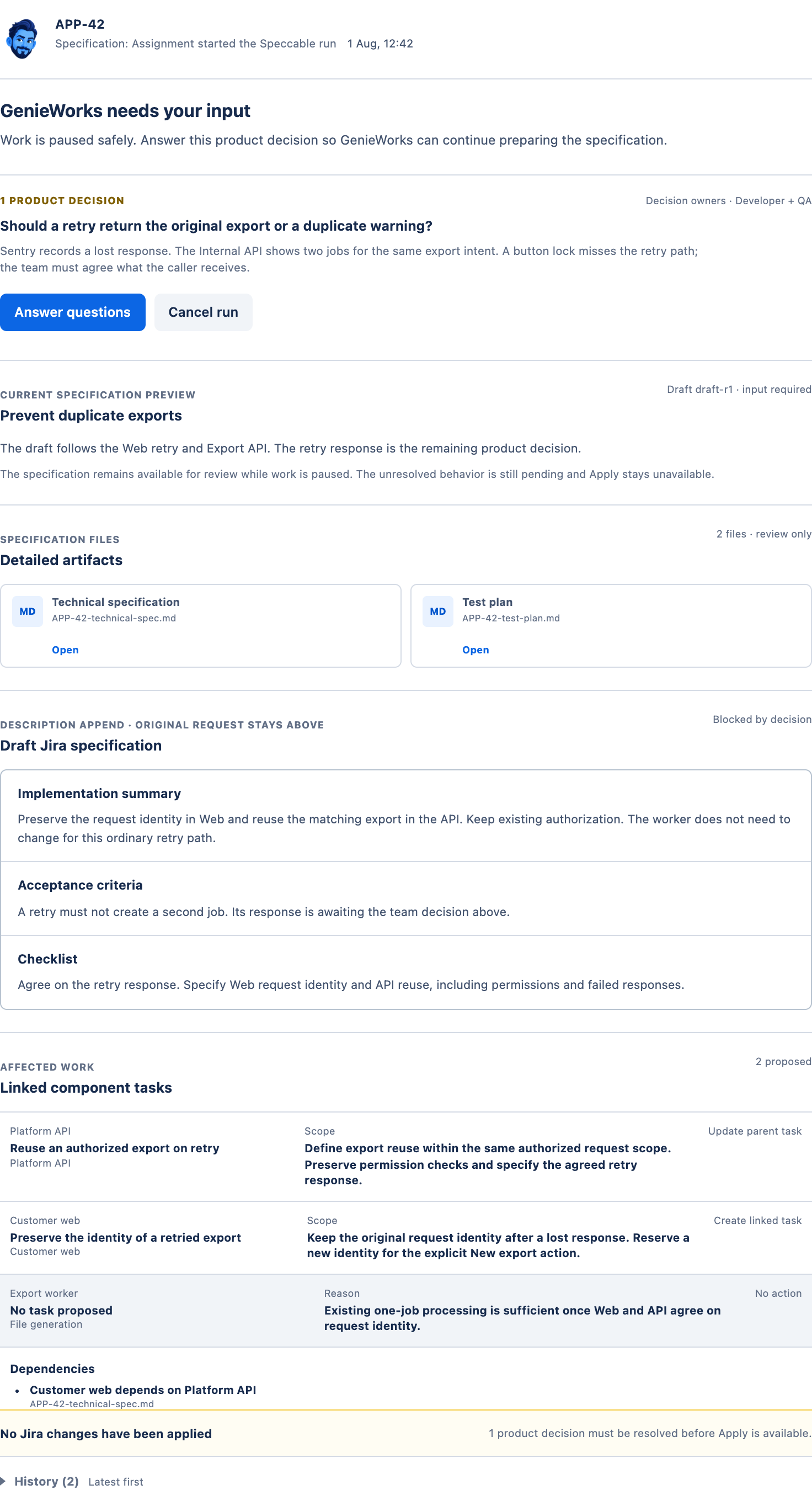
The retry can reuse the job. Should it return the original export or show a duplicate warning?
Return the original export. @Sam, does that match the behavior QA expects?
Agreed. Only an explicit New export should create another job. Include denied access in the checks.
Updated the specification: retry reuse, explicit New export, and permission checks now have separate acceptance criteria.
Team decision carried into the spec
04 · MAKE IT EXECUTABLE
The specification connects the evidence and agreed behavior to component changes, acceptance criteria, and planned checks. Open the decision and the resulting specification below.
 Open full screenshot
SPECIFICATION REVIEW
A separate item-level review finds the vague instruction and makes the required behavior explicit before handoff.
Before review Handle retries safely
After correction Web keeps the original request identity after a lost response. The API returns the existing authorized export. New export creates a fresh identity.
Automatic specification correction enabled in this example. Default review records gaps; correction is optional.
The team reviews and chooses Apply. The test plan describes checks to run; it is not a test result. Applying a specification does not approve code or release a change.
BEYOND THIS BUG
The same shared project context supports a product idea or a supplied design. What changes is the investigation and the agreement the team needs.
“Let customers schedule exports” leaves frequency, permissions, failure handling, and ownership undecided. GenieWorks works through those decisions and the affected components before turning the idea into scope, acceptance criteria, and a test plan.
A SUPPLIED DESIGN · SEPARATE EXAMPLE
An approved export-history drawer should not become a convenient modal. GenieWorks maps the design to your existing UI and specifies what to reuse, adapt, or create.
Placement, action order, selected-row visibility, responsive behavior, and loading, empty, and error states become requirements. Unresolved differences become questions.
Design handoff · Export history
| Export | Status |
|---|---|
| September | Ready |
| August | Ready |
| July | Ready |
1–3 of 12 · Page 1
2 Export details
September export
3 Retry history
Download · Close
Existing table, filters, and pagination. Keep grouping, row density, and column order.
Existing details drawer. Add retry history; keep right-hand placement and action order.
The approved design needs a retry timeline. In this example, no existing pattern fits.
Must stay true Filters above the table · Details in the right-hand drawer · Selected row stays visible
Mobile layout and loading, empty, and error states come from supplied requirements or existing patterns. Unresolved differences stay as questions.
THE APPROACH TRAVELS WITH THE TASK
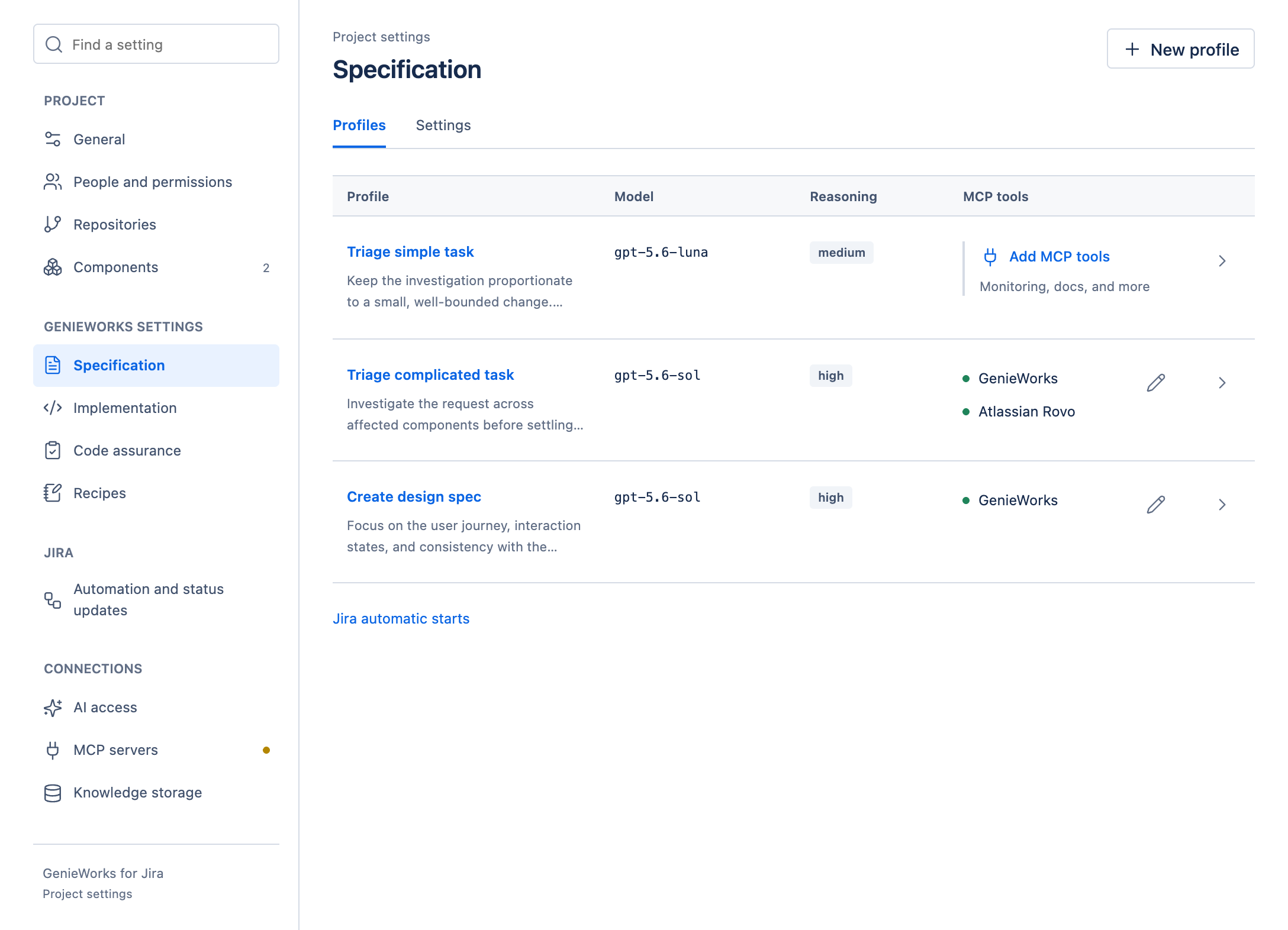
GenieWorks assesses complexity and selects a specification profile. Your team controls the available models, reasoning depth, instructions, and connected tools. The settings below show those choices.
A bounded fix with focused evidence and checks
Root cause, component impact, and product decisions
User journeys, existing UI, and visual requirements
 Open full screenshot
In our workflow, GPT-5.6 Sol at high reasoning plans the work; Luna implements against the specification and the same acceptance criteria. GenieWorks recommends an implementation model and reasoning level from the agreement and your configured choices.
Our hands-on estimate: hundreds of developer hours saved on investigation and specification. Experience-based estimate, not a measured customer result.
THE AGREEMENT IS THE STARTING POINT
Follow APP-42 into implementation, where the same criteria expose a missed retry path.